How to Get a Saudi Nursing License (SCFHS Mumaris Plus & SNLE Guide)
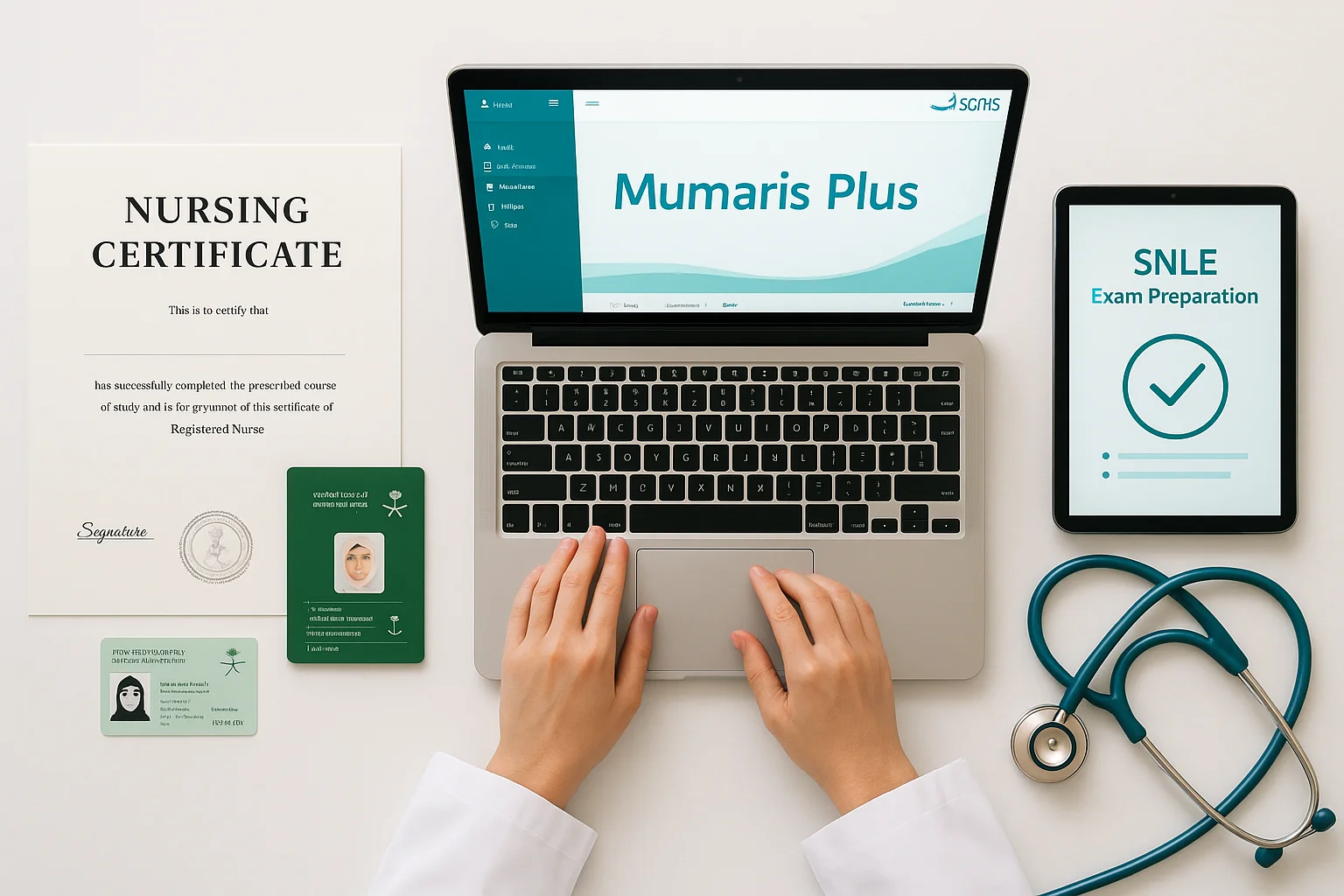
For both local and expatriate nurses, obtaining a Saudi nursing license is mandatory before practicing legally in hospitals, clinics, or healthcare facilities within the Kingdom.
This guide explains:
- SCFHS licensing requirements
- Mumaris Plus registration
- SNLE exam process
- DataFlow verification
- Fees and timelines
- Professional classification
- Registration renewal
- Common licensing mistakes
What Is the Saudi Nursing License?
The Saudi nursing license is an official SCFHS authorization allowing nurses to practice legally in Saudi Arabia.
The license confirms that a nu
- Holds an accredited qualification.
- Has verified credentials through SCFHS.
- Passed the SNLE exam.
- Meets professional, ethical, and regulatory standards.
No nurse may legally work in Saudi Arabia without valid SCFHS licensing and registration.
What Is SCFHS?
The Saudi Commission for Health Specialties (SCFHS) is the official regulatory authority responsible for healthcare professional licensing in Saudi Arabia.
SCFHS oversees:
- Professional classification
- Licensing
- Registration
- Continuing education
- Professional standards
- Licensing examinations
Many nurses refer to SCFHS informally as the “Saudi Nursing Council” or “Saudi Council for Nurses.”
What Is Mumaris Plus?
Mumaris Plus is SCFHS’s official digital licensing portal used by healthcare professionals in Saudi Arabia.
Through Mumaris Plus, nurses can:
- Create professional profiles
- Apply for professional classification
- Upload licensing documents
- Apply for the SNLE exam
- Track application status
- Renew licenses
- Manage CPD records
All licensing communication and status updates are handled through the Mumaris Plus platform.
Understanding the Saudi Nursing License Process
The Saudi nursing licensing pathway generally includes:
- DataFlow verification
- Mumaris Plus registration
- Professional classification application
- SNLE eligibility approval
- SNLE examination
- Professional registration
- License issuance
The process may vary slightly depending on:
- Nationality
- Nursing category
- Experience level
- SCFHS updates
Eligibility Requirements for Saudi Nursing License
To apply for licensing, you must meet SCFHS criteria:
- Education: BSN or equivalent degree from an accredited institution.
- Students: Final-year BSN students or interns are eligible to sit for SNLE.
- Foreign nurses: Must provide a valid nursing license from the home country and proof of at least 2 years’ experience.
- Documents required (scanned and uploaded to Mumaris Plus):
- Passport/Iqama (for expatriates) or National ID (for Saudis).
- Degree certificate and official transcript.
- Internship completion certificate (if applicable).
- Good standing certificate (issued within 6 months).
- Nursing license/registration from home country.
- Passport photo.
- Employment letter (for professional registration).
- Passport/Iqama (for expatriates) or National ID (for Saudis).
- Primary Source Verification (DataFlow): All degrees, licenses, and certificates must be authenticated through SCFHS’s verification partner before classification is granted.
SNLE Exam Eligibility Requirements
To become eligible for the SNLE examination, nurses typically must:
- Complete Mumaris Plus registration
- Submit required documents
- Pass DataFlow verification
- Obtain SCFHS eligibility approval
Only approved candidates can schedule the SNLE through Prometric testing systems.
Saudi Nursing License for Foreign Nurses
Foreign-trained nurses from countries such as:
- Philippines
- India
- Pakistan
- Egypt
- Jordan
- South Africa
commonly follow the same SCFHS licensing process.
Requirements usually include:
- Nursing degree
- Professional license
- Clinical experience
- DataFlow verification
- SNLE eligibility
- Professional classification
Licensing standards apply regardless of nationality.
The Mumaris Plus Portal
Mumaris Plus is SCFHS’s unified digital platform for health practitioners. Through it you:
- Create an account and profile.
- Submit applications for Professional Classification and Registration.
- Upload documents for verification.
- Apply for the SNLE exam.
- Manage renewals and licensing services later.
Link to: SCFHS Mumaris Plus Portal
Step-by-Step Licensing Process
Step 1: Create a Mumaris Plus Account
Register using:
- Passport/Iqama details
- Email address
- Personal information
Account activation occurs through email verification.
Step 2: Apply for Professional Classification
- Upload all required documents.
- Pay classification fees (~SAR 1,000–1,500).
- Wait for DataFlow verification approval.
- Once approved, your classification is valid for 1 year for registration purposes.
Step 3: Apply for the SNLE Exam
- Submit your SNLE application through Mumaris Plus.
- Receive an eligibility letter and scheduling permit.
- Book a test slot at a Prometric center (Saudi Arabia or abroad).
Step 4: Prepare for the SNLE
The SNLE assesses readiness for safe nursing practice.
- Format: 200 MCQs (up to 10% pilot/unscored), split into 2 blocks of 100 questions each.
- Timing: 120 minutes per block + 30-minute break.
- Scoring: Scale 200–800; passing score is 500.
- Retakes: Up to 4 times per year allowed.
Blueprint areas tested
- Nursing Fundamentals (assessment, pharmacology, nutrition, basic care).
- Adult Nursing (medical, surgical, critical care, community, psychiatric).
- Maternal & Child Nursing (maternity, gynecology, neonatal, pediatric).
- Nursing Management & Leadership (quality, safety, informatics, team coordination).
Recommended textbooks:
- Brunner & Suddarth’s Medical-Surgical Nursing
- Timby’s Fundamentals of Nursing
- Wong’s Essentials of Pediatric Nursing
- Kozier & Erb’s Fundamentals of Nursing.
Step 5: Exam Day
- Bring passport/Iqama and scheduling permit.
- Biometric verification (photo, fingerprint) will be done.
- Prohibited items: phones, notes, electronic devices.
- Testing sessions are video and audio recorded.
Step 6: Receive Results
- Results released 2–6 weeks after exam window closes.
- You receive two reports:
- Statement of results.
- Performance feedback comparing you to other test-takers.
- Statement of results.
Step 7: Apply for Professional Registration
- After passing, log into Mumaris Plus and apply for registration.
- Submit employment letter from your Saudi employer.
- Pay registration fees.
- Receive your Professional License Certificate (digital).
5. Exam Attempts and Retake Policy
- Up to 4 attempts per year are allowed.
- If failed twice, SCFHS classification rules apply (extra requirements after 2 years of graduation).
- Candidates who pass can retake the exam to improve their score for competitive residency placement.
6. Required Documents Checklist
- Valid passport or Iqama/National ID.
- Degree and transcript.
- Internship completion certificate.
- Nursing license from home country.
- Certificate of Good Standing (issued within 6 months).
- Employment letter (for registration).
- Passport-sized photo.
- Verified DataFlow report.
- Payment receipts (SCFHS fees, exam fees).
7. Costs Involved (Approximate)
- Professional Classification & Registration Fees: SAR 1,000–1,500.
- DataFlow Verification Fees: SAR 800–1,200 (depending on number of documents).
- SNLE Exam Fee: ~SAR 1,000 (varies by Prometric location).
- License Renewal Fees: payable every 2 years.
8. Practical Tips for Nurses
- Start document verification early; DataFlow can take weeks.
- Book SNLE exam slots quickly as they fill fast.
- Study from the official exam blueprint and recommended resources.
- Use SCFHS’s mock exams for practice.
- Always check SCFHS announcements for updated policies.
Read also: Qualifications to Work as a Nurse in Saudi Arabia in 2026
How to Renew Saudi Nursing License
License renewal is completed through Mumaris Plus.
Renewal commonly requires:
- CPD credits
- Updated professional information
- Renewal fee payment
- Active professional standing
Nurses should begin renewal procedures early to avoid license expiration.
9. Frequently Asked Questions
Is the SNLE mandatory for foreign nurses?
Yes. All expatriate and local nurses must pass SNLE.
How long is the Saudi nursing license valid?
Usually 2 years, renewable through Mumaris Plus.
Where can I take the SNLE exam?
At Prometric centers in Saudi Arabia or internationally.
What is the passing score?
500 on the SNLE scale (200–800).
Where can I take the SNLE exam?
At authorized Prometric centers:
- Inside Saudi Arabia
- Internationally
What if I fail the SNLE?
You can retake it, up to four times annually.
What happens if my classification expires?
If you don’t complete registration within one year of classification approval, you must reapply.
Conclusion
Obtaining a Saudi nursing license in 2026 requires careful completion of:
- DataFlow verification
- Mumaris Plus registration
- Professional classification
- SNLE examination
- Professional registration
Nurses who understand the licensing process early can reduce delays, avoid application mistakes, and transition more smoothly into Saudi Arabia’s healthcare sector.
With growing healthcare investment and increasing demand for qualified nurses, Saudi Arabia continues to offer strong professional opportunities for licensed nursing professionals worldwide.