Qualifications to Work as a Nurse in Saudi Arabia in 2026
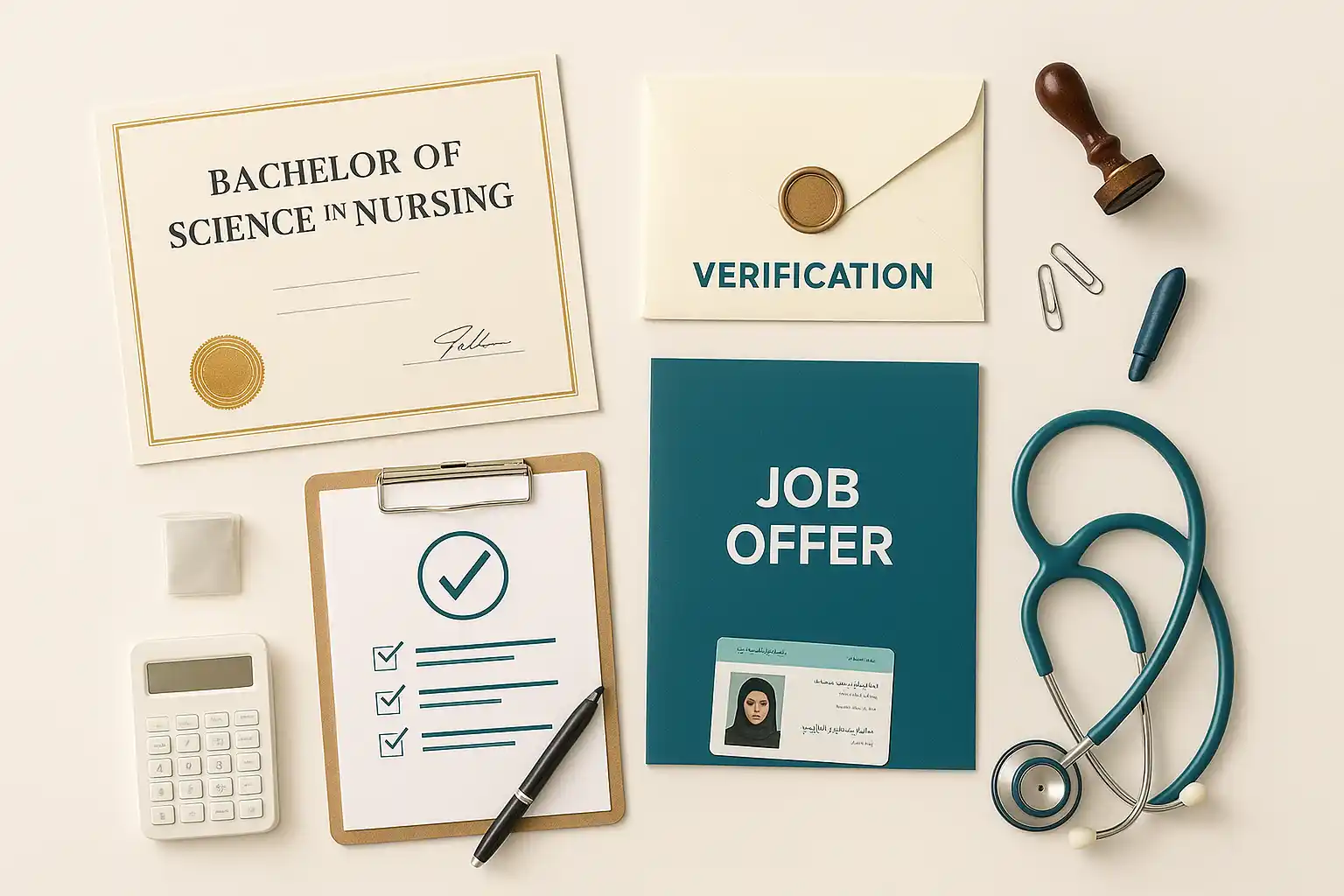
However, working legally as a nurse in Saudi Arabia requires meeting strict Saudi Commission for Health Specialties (SCFHS) licensing and professional classification requirements.
To work as a nurse in Saudi Arabia in 2026, nurses typically need:
- A recognized nursing qualification
- Active nursing license from their home country
- Clinical work experience
- DataFlow verification
- SCFHS eligibility approval
- Successful completion of the licensing exam
- Professional classification through Mumaris+
Understanding these requirements early can help nurses avoid delays, licensing issues, and rejected applications.
1. Academic Qualifications
To be eligible for nursing practice in Saudi Arabia, you must hold a Bachelor of Science in Nursing (BSN) from a recognized institution.
- BSN is the preferred qualification for most employers and required for professional classification by SCFHS.
- Diploma or GNM (General Nursing and Midwifery) holders may still qualify for certain roles but often face limited classification and slower career progression.
Required academic documents:
- Degree certificate (BSN or equivalent)
- Transcript of records
- Nursing license or registration from your home country
- Certificate of good standing (issued within 3–6 months)
- Experience letters from previous employers
Ensure all documents are in English or Arabic and fully attested by relevant authorities (Ministry of Education, Foreign Affairs, and the Saudi Embassy in your country).
2. Experience Requirements
Most Saudi employers require at least two years of post-graduate clinical experience. Some hospitals may demand additional specialty experience for advanced units such as ICU, NICU, or operating theatres.
- Entry-level roles: 2 years minimum in general nursing
- Specialized units: 2–5 years in the related specialty
- Leadership/educator roles: 5+ years with management or teaching experience
Employers look for clear, verifiable experience letters detailing your job title, responsibilities, and duration of employment.
Can Fresh Graduate Nurses Work in Saudi Arabia?
Fresh graduate nurses without clinical experience may face difficulty obtaining SCFHS classification and employment approval in Saudi Arabia.
Most employers and licensing pathways prefer nurses with:
- At least two years clinical experience
- Active nursing practice
- Verifiable hospital employment
Some exceptions may apply depending on:
- Employer policies
- Nationality pathways
- Saudi-trained nurses
- Internship structure
Requirements may vary according to SCFHS updates and hospital recruitment policies.
3. Primary Source Verification (DataFlow / PSV)
Before you can apply for a Saudi license, your credentials must undergo Primary Source Verification (PSV) via DataFlow or an equivalent verification service approved by SCFHS.
What PSV does:
It confirms the authenticity of your:
- Degree and transcripts
- Nursing license
- Employment certificates
- Good standing certificate
Processing time:
Approximately 30–60 working days, depending on your institution’s responsiveness. Begin this step early—it’s the most time-consuming part of the process.
Beginning DataFlow early is strongly recommended because it is often the most time-consuming step in the Saudi nursing licensing process.
4. SCFHS Registration and Mumaris+
Once your verification is in progress, create an account on Mumaris Plus, the SCFHS online platform for healthcare professionals.
Through Mumaris+, you will:
- Submit your verified documents
- Apply for eligibility classification
- Receive your eligibility number (required to book your licensing exam)
- Track your application status
All correspondence, updates, and licensing actions occur inside the Mumaris+ system. Keep your login credentials secure and monitor regularly.
What Is Mumaris+?
Mumaris+ is the official online licensing portal used by the Saudi Commission for Health Specialties (SCFHS).
Healthcare professionals use Mumaris+ for:
- Professional classification
- Exam eligibility
- License renewal
- Registration updates
- CPD management
- Professional verification
Nurses should regularly monitor their Mumaris+ account for:
- Status updates
- Requests for clarification
- Verification notices
- Licensing decisions
5. SCFHS Licensing Exam for Nurses (SNLE)
All foreign-trained nurses must pass the Saudi Nursing Licensing Exam (SNLE), administered by Prometric under SCFHS supervision.
Key details:
- Exam type: Multiple-choice questions
- Eligibility: Only after SCFHS approval via Mumaris+
- Purpose: To evaluate clinical knowledge and ensure compliance with Saudi nursing standards
- Attempts: Limited; candidates should prepare thoroughly before booking
After passing, SCFHS issues a professional classification certificate, confirming your qualification to work legally in Saudi Arabia.
Difference Between SNLE and Saudi Prometric Exam
Many nurses use the terms “SNLE” and “Saudi Prometric Exam” interchangeably.
Generally:
- SNLE refers to the Saudi Nursing Licensure Examination pathway
- Prometric refers to the testing platform through which the exam is administered
Both are linked to SCFHS licensing and professional classification requirements.
6. Professional Classification and License Issuance
Once you pass the SNLE and DataFlow verification, SCFHS will classify your professional level (e.g., Staff Nurse, Registered Nurse, Senior Nurse, Specialist Nurse).
Your classification determines:
- Salary scale
- Job title
- Scope of practice
After classification, you receive your practice license, which is mandatory for all employment contracts in Saudi healthcare facilities.
7. Job Offer and Work Visa
After obtaining your classification, you can proceed with recruitment. Saudi hospitals or recruitment agencies will issue a job offer letter outlining:
- Position title and department
- Basic salary and allowances
- Contract duration (usually 1–2 years)
- Working hours, leave, and housing details
Your employer will handle the employment visa process. This includes medical exams, police clearance, and document attestation before your visa is stamped by the Saudi Embassy.
8. Pre-Employment Medical and Background Checks
Before finalizing your visa, you must undergo:
- Medical examination (Hepatitis, HIV, TB, etc.)
- Vaccination verification (especially Hepatitis B, MMR, COVID-19)
- Police clearance certificate
- Certificate of good standing from your national nursing board
These are essential for both visa approval and hospital onboarding.
9. Language and Skills Requirements
While Arabic is the local language, English proficiency is mandatory in almost all Saudi hospitals—especially private, tertiary, and international facilities.
- Clinical communication, documentation, and patient care are conducted in English.
- Basic Arabic helps in patient interaction but is not required for licensing.
Soft skills such as teamwork, cultural adaptability, and professionalism are valued equally with technical competence.
10. Continuing Registration and License Renewal
Your SCFHS nursing license must be renewed periodically via Mumaris+.
- Renewal intervals: every 2–3 years (check SCFHS policy).
- Continuing Professional Development (CPD) credits are required for renewal.
- Nurses must maintain a record of their professional education and training activities to remain eligible for renewal.
11. Recommended Additional Certifications
To enhance employability and salary potential, consider completing:
- ACLS (Advanced Cardiac Life Support)
- BLS (Basic Life Support)
- PALS (Pediatric Advanced Life Support)
- CCRN, CNOR, or oncology nursing certifications
- Postgraduate diplomas or master’s in nursing education or leadership
Nurses with specialized credentials are prioritized by major hospitals and often qualify for senior-level positions or teaching roles.
12. Timeline and Estimated Costs
Total estimated time: 2–4 months (average)
Total personal expenses: USD 400–700 depending on country and document requirements
13. Common Mistakes to Avoid
- Submitting incomplete or unverified documents can cause significant delays in SCFHS processing.
- Booking the wrong exam category — always confirm the correct SCFHS specialty before registration.
- Using unauthorized recruitment agencies — only work with MOH-accredited agencies.
- Ignoring DataFlow follow-ups — missing institution verification leads to application rejection.
14. Quick Checklist Before Applying
- BSN degree and transcript (attested)
- Active home-country nursing license
- Good standing certificate
- Passport valid for at least six months
- Two or more years of nursing experience
- DataFlow verification initiated
- Mumaris+ registration completed
- SCFHS eligibility number received
- Prometric exam passed
- Job offer and employment visa secured
- Medical and police clearance completed
Read next: Process for Nurses to Start Work in Saudi Arabia
15. Frequently Asked Questions
Q: Is Saudi Arabia a Good Country for Nurses?
A: Saudi Arabia remains one of the largest nursing employment markets in the GCC because of:
- Tax-free salaries
- Housing allowances
- Expanding healthcare infrastructure
- Large-scale hospital projects
- Strong demand for nurses
Many expatriate nurses relocate to Saudi Arabia because of:
- Career advancement opportunities
- Competitive compensation
- International clinical exposure
- Specialized hospital systems
Q: Can nurses apply to Saudi Arabia without experience?
A: Most employers and licensing pathways prefer nurses with at least two years of experience.
Q: Is DataFlow mandatory for nurses in Saudi Arabia?
A: Yes. Most foreign-trained nurses are required to complete Primary Source Verification (PSV) through DataFlow or another approved provider.
Q: Is a nursing exam required to work in Saudi Arabia?
A: Yes. The SCFHS Licensing Exam (SNLE) is mandatory for nearly all foreign-trained nurses.
Q: Can diploma nurses work in Saudi Arabia?
A: Yes, but opportunities are limited. BSN holders are preferred for most positions and higher classifications.
Q: How long does the licensing process take?
A: Typically 2–4 months from document submission to license issuance, depending on verification speed.
Q: Do I need to speak Arabic?
Not necessarily. English is the working language in hospitals, but learning basic Arabic is beneficial for patient communication.
Q: How often must I renew my SCFHS license?
Every 2–3 years, with required CPD hours for renewal.
Q: What is the minimum qualification for nurses in Saudi Arabia?
A: A recognized nursing diploma or BSN qualification is generally required, although BSN is preferred for most professional classifications.
Conclusion
Becoming a licensed nurse in Saudi Arabia demands careful preparation, verified documentation, and compliance with SCFHS regulations. Nurses who hold a BSN, possess at least two years of clinical experience, and pass the SCFHS licensing exam can access some of the most rewarding nursing positions in the Middle East.
With clear understanding of these qualifications and steps, you can confidently begin your pathway toward a nursing career in Saudi Arabia in 2026.